Blue Cluster calls for an innovation-driven European Ocean Act


The European Commission is preparing a new European Ocean Act. This legislation will shape how Europe develops and manages its seas in the decades ahead. For Blue Cluster, the message is clear: the Ocean Act must become a strategic enabler for innovation, deployment and scaling of sustainable ocean industries, rather than a control instrument.
How Europe plans and regulates its sea areas will determine how quickly offshore energy, maritime technologies and new economic activities can develop. This is the moment to create a framework that enables innovation instead of slowing it down. That is why we submitted a position paper to the European Commission with concrete recommendations.
European sea basins as strategic assets
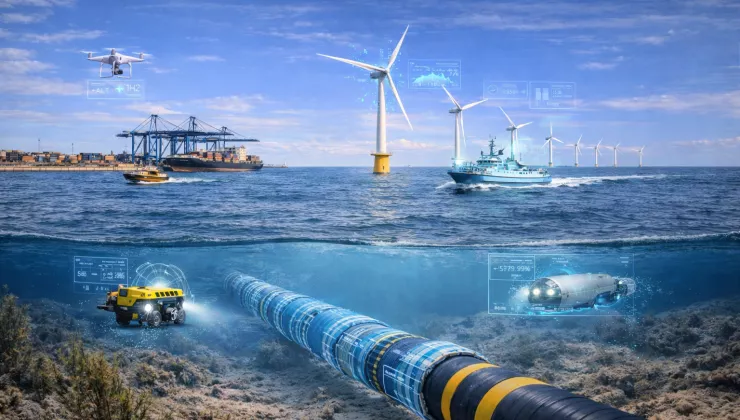
Europe’s seas are crucial to its future. They provide space for:
- Renewable energy
- New food systems
- Digital and energy infrastructure
- Security and monitoring
- Nature restoration
Strategic planning at European level, aligned with national Maritime Spatial Plans, can turn Europe’s sea basins into a driver of energy autonomy, economic growth and geopolitical resilience.
The Ocean Act should therefore look beyond national borders and strengthen strategic planning at sea-basin level.

Security and robustness by design
Offshore infrastructure is critical to our society. Energy production, data cables, ports and digital systems form the backbone of Europe’s economy.
New infrastructure must be designed from the outset with built-in robustness, redundancy and cyber-resilience. Security should not be an afterthought, but a fundamental design principle.
At the same time, increased offshore deployment creates opportunities: stronger presence at sea, smarter sensor networks and improved maritime situational awareness.
Multi-use as the default spatial model
The future offshore system is integrated. Energy production, aquaculture, nature restoration, data and security can reinforce one another.
Blue Cluster therefore advocates making multi-use the default spatial model. The concept of “Mariparks” demonstrates how shared infrastructure and services can maximise economic value while delivering a net positive impact on marine ecosystems.
Single-use zoning should be the exception, not the rule.

Nature as infrastructure
Sustainable offshore development must go beyond minimising impact. It should actively contribute to biodiversity and ecosystem restoration.
Nature-Inclusive Design (NID) and Nature-Based Solutions (NBS) can ensure that offshore infrastructure strengthens marine ecosystems, for example through artificial reefs, smart substrate design and enhanced ecosystem services.
Climate objectives, biodiversity goals and industrial development should should be aligned and designed to strengthen one another.
Clusters as key drivers
Europe has world-class knowledge institutions and innovative companies. What is missing is scale and industrial roll-out.
Innovation clusters such as Blue Cluster connect companies, research institutions and governments. They reduce risk, accelerate collaboration and help move projects from pilot phase to deployment.
The Ocean Act should recognise clusters as strategic implementation partners, enabling Europe to shift from pilots to industrial roll-out.
In the coming months, the Ocean Act will take further shape. Blue Cluster remains committed to ensuring that this legislation becomes a true enabler of innovation, resilience and sustainable growth in Europe’s sea basins.
Together, we can build strong, secure and future-proof European seas.