Look back at Ostend at Anchor


Ostend at Anchor, held from May 28 through 31, once again provided an excellent opportunity to introduce the blue economy to a broad audience. The Blue Cluster participated in various panel discussions on current maritime issues and engaged in dialogue about how we can use our North Sea in a sustainable, safe, and forward-looking manner. The central question was how we can better care for the sea without losing sight of its economic, social, and ecological functions. This question touches on many of the themes the Blue Cluster is actively addressing today: from coastal protection and climate adaptation to multiple land uses, food production, maritime safety, and nature restoration. On the exhibition grounds, visitors could explore three booths focused on our priority areas of work:
Security
This booth highlighted the growing strategic importance of the North Sea and the need for better protection of maritime infrastructure, offshore energy installations, and other critical activities at sea.
Coastal Management
The coastal management booth highlighted the challenges facing our coastline. Visitors learned how innovation and collaboration can contribute to a resilient coastline, with a focus on climate change, storms, sea-level rise, and nature-based solutions.
Multi-use
The multi-use booth focused on the multiple uses of space. In a heavily used North Sea, it is becoming increasingly important to intelligently combine functions, such as energy production, nature conservation, aquaculture, recreation, and research.
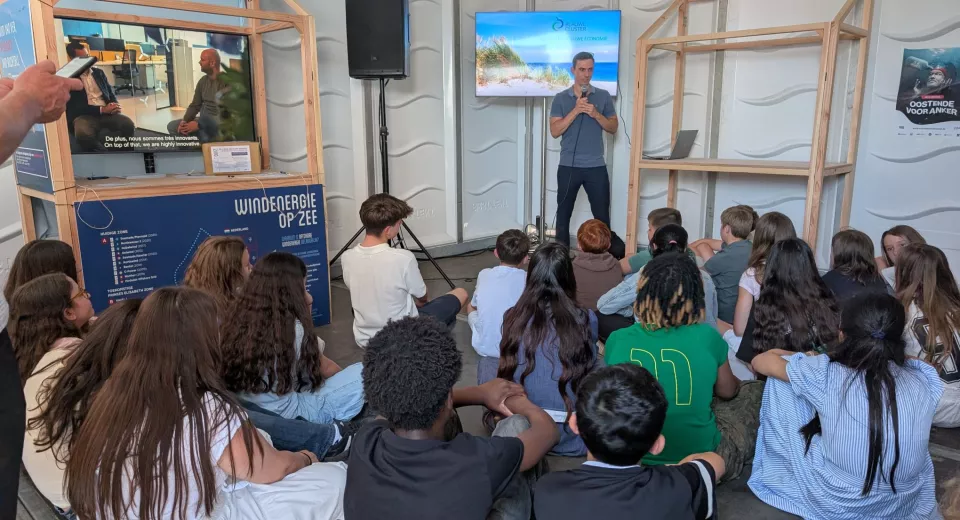
In addition, the Blue Cluster organized guided tours for schools. This gave young people an accessible insight into the many activities on and around the sea, as well as the role that innovation can play in a healthy and future-proof North Sea.
Conversations about a changing sea
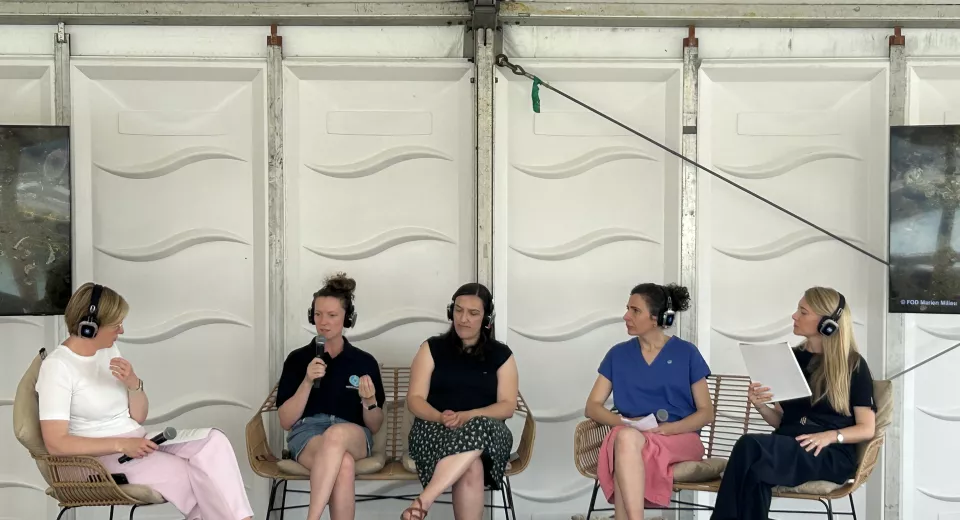
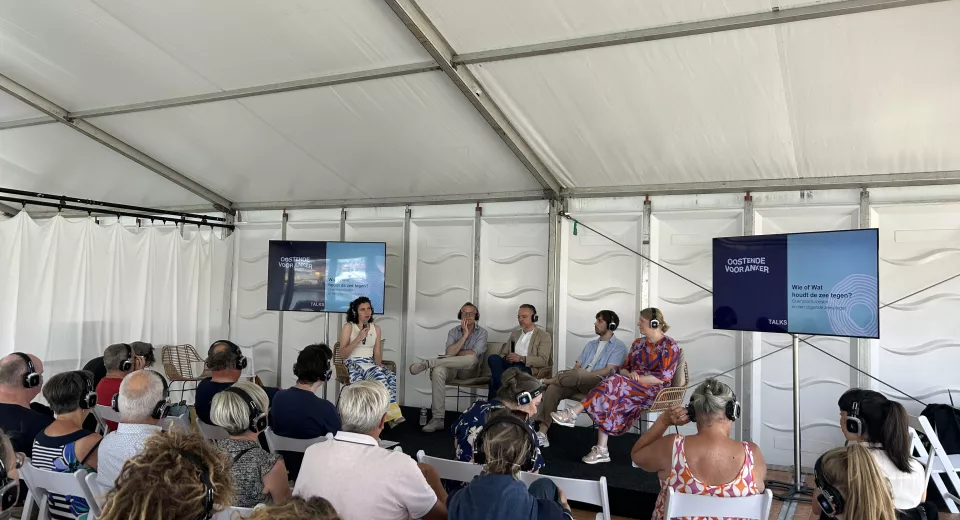
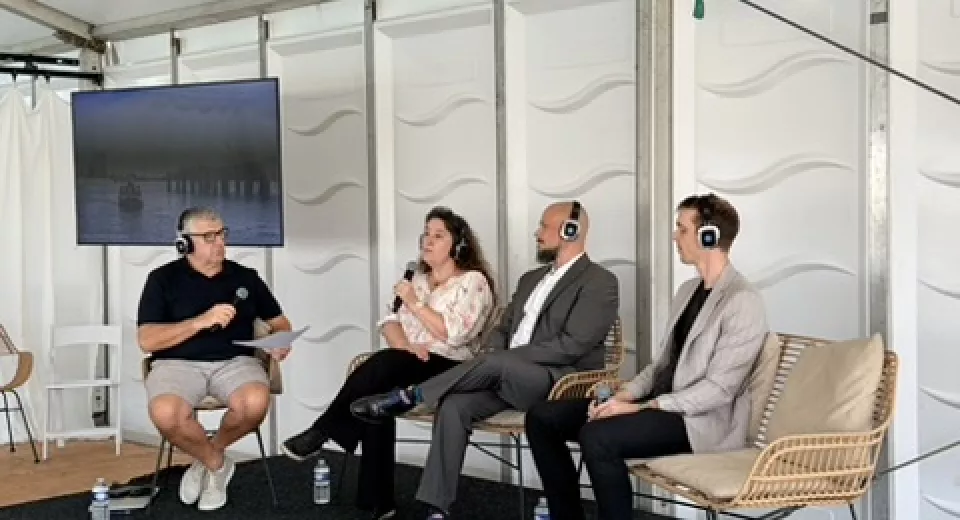
During Ostend at anchor representatives from the Blue Cluster participated in various panel discussions. Each panel highlighted, in its own way, how rapidly our sea and coast are changing, and how important it is to act in a timely, informed, and collaborative manner.
The panel 'Who or what can stop the sea?' focused on coastal protection. The coast was not viewed as a fixed line between land and sea, but as a dynamic system in which wind, waves, sand, dunes, plants, animals, and people constantly interact. Rising sea levels, storm surges, and pressure on the coast make it clear that coastal protection is more than just higher dikes or sturdier infrastructure. Nature-based solutions—such as dunes, beaches that adapt to sand transport, and natural structures at sea—can contribute to a safer and more resilient coast. At the same time, it was emphasized that such solutions require space, time, knowledge, and collaboration.
The 'Wind Force 10' panel also highlighted how closely weather, climate, and the sea are intertwined. The participants discussed storms, ocean currents, global warming, hydrography, and how ports, offshore infrastructure, and coastal communities must prepare for changing conditions. In this context, the North Sea is not only an economic zone but also a climate system whose temperature, currents, waves, and weather phenomena have a major impact on fisheries, biodiversity, and maritime activities.
The panel 'Our Food Chain Under Pressure' highlighted the link between ecosystem health and food production. Fish migration, overfishing, climate change, pollution, and habitat loss are putting pressure on the marine food chain. The speakers discussed the migration of species such as eel, alternative fishing techniques, changing catch patterns, and the role of aquaculture. They also addressed the question of how we, as humans, can limit negative impacts on people, animals, and the planet, and how we can better inform consumers about the availability of fish, shellfish, and crustaceans.
In 'Sea Battle', the focus was explicitly on sustainable restoration of the North Sea. The Belgian North Sea was described as our country’s largest nature reserve, but at the same time as one of the most intensively used marine areas in the world. Topics discussed included nature restoration, flat oyster reefs, artificial reefs, nature-inclusive design, sustainable fisheries, and the role of businesses, science, policy, and civil society. The key message: nature restoration is not the responsibility of a single organization or sector, but a shared responsibility.
From knowledge to scaling up
The discussions during the event made it clear that Belgium possesses a great deal of expertise, ambition, and innovative capacity to further expand nature restoration in the Belgian sector of the North Sea. At the same time, the next step is at least as important: moving from pilot projects and knowledge-building to acceleration and scaling up. The Federal Marine Environment Service also emphasized in its review that the next phase requires greater collaboration, increased investment, and a sustained commitment to communication and public engagement. Topics discussed during the event included projects related to oyster reef restoration, scientific monitoring, financing, value creation, and enforcement.
For the Blue Cluster, it is important that nature restoration and a sustainable blue economy go hand in hand. Economic activities at sea must be carefully integrated, but—provided there is a sound framework—they can also contribute to the restoration, strengthening, and protection of marine ecosystems. Companies can play a key role in this, including through innovative techniques, monitoring, design choices, nature-inclusive design, and investments that enable nature restoration. The discussions during Ostend at Anchor showed that nature restoration, coastal protection, food production, offshore infrastructure, and climate adaptation are becoming increasingly intertwined.
A healthy ocean starts with engagement
The partnership with Ostend at Anchor also underscored the importance of communication and public engagement. Nature restoration is not merely a technical or policy-related issue. It is also about how citizens, young people, businesses, and organizations view the sea and the value we place on it. By making nature restoration visible and tangible, public support for a healthy North Sea grows. That support is necessary to make long-term choices that are both ecologically and socially sound.
The Blue Cluster therefore looks back positively on four days of encounters, dialogue, and inspiration. Ostend at Anchor brought the general public closer to the sea, while the nature restoration event provided the in-depth insights needed to take the next steps. Together, we will continue to work toward a North Sea that offers space for both sustainable economic development and strong, resilient nature.