Integrating Floating Solar into Offshore Wind Farms: Smart Planning in SWiM


Wind farms are already connected to the onshore grid through powerful export cables. They are also designated zones where fishing and commercial shipping are restricted. Installing floating solar systems between wind turbines therefore avoids spatial conflicts while making use of existing infrastructure.
There is another advantage: wind and solar complement each other seasonally. Offshore wind produces most electricity during winter, while solar power production peaks in summer. Sharing the same grid connection allows both technologies to use the cables more efficiently throughout the year. Research in the Belgian North Sea has demonstrated this strong complementarity between offshore wind and floating photovoltaics.
Finding the Best Connection Points
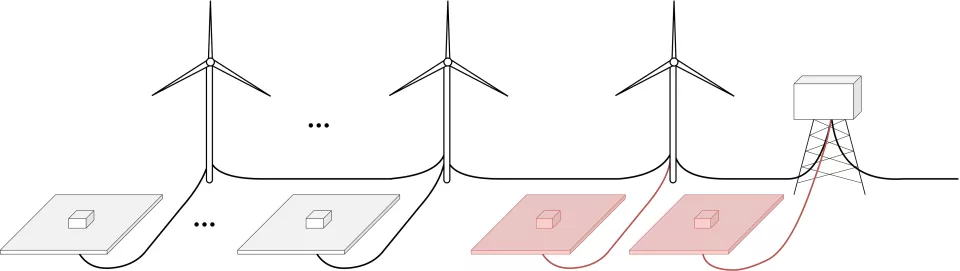
Within the SWiM project, researchers go one step further. Beyond sharing export cables, the project investigates where exactly floating solar systems should be connected inside a wind farm.
To answer this question, the team uses optimal power flow simulations. These simulations model how electricity moves through the internal cable network that connects the wind turbines to the offshore substation. They show where spare electrical capacity is available and where additional power could cause congestion or overload.
Different connection options for floating solar systems are tested in the model. The objective is clear:
- Integrate as much additional solar power as possible
- Avoid hindering the electricity produced by existing wind turbines
- Prevent cable overloading
- Minimise transmission losses

Complementarity of offshore wind and floating solar in the Belgian North Sea. Delbeke et al., 2023 .
What Did We Learn?
The simulations show that floating solar systems are best connected:
- Directly to the offshore substation; or
- To wind turbines located closest to the substation
At these locations, the network can support the highest additional power transfer. At the same time, transmission losses remain limited.
These insights are an important step toward efficient hybrid offshore energy systems. By carefully planning grid integration, floating solar can be added to existing wind farms without major additional infrastructure.
Smart generation expansion planning ensures that offshore space and grid capacity are used efficiently, helping Europe move toward a more flexible, resilient and integrated renewable energy system.