Belgium’s offshore wind sector remains strong in a challenging context


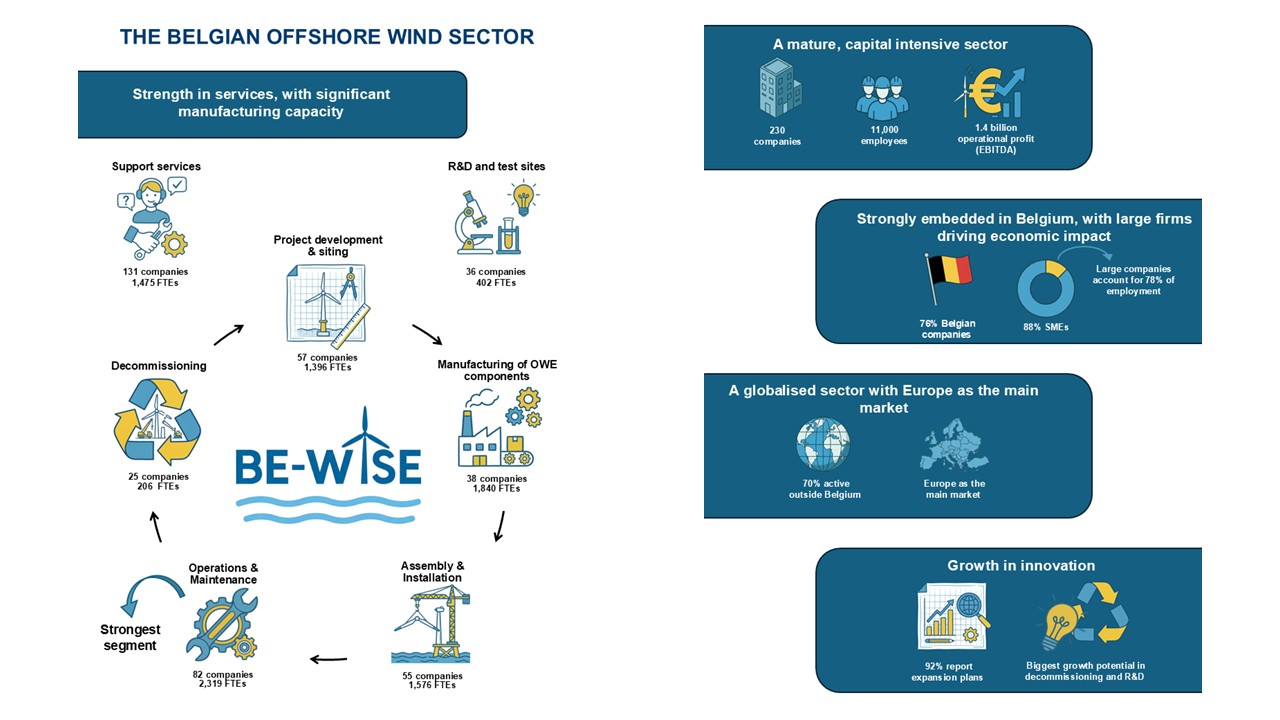
The study, carried out by Simon Rogissart (Ghent Institute for International and European Studies, Ghent University), is part of the BE-WISE project and combines a unique company database with a sector-wide survey (April–June 2025) and recent financial data. In total, 230 Belgian companies with offshore wind activities were identified and analysed.
Blue Cluster supported the rollout of the survey and thereby contributed to the evidence base for this analysis. The report offers a current snapshot of the sector, covering economic impact, position in the value chain, international presence and policy preferences.
230 companies, 11,000 jobs
Belgium boasts 230 companies active in offshore wind, more than 80% of which are based in Flanders. Together, they account for around 11,000 jobs, representing 11.5% of all offshore wind employment in Europe. In 2024, the sector generated an operating profit of €1.4 billion.
Offshore wind is also a highly capital-intensive sector. With €22 billion in assets, it involves large-scale infrastructure and investment-heavy projects. As a result, the sector is sensitive to inflation, rising interest rates and disruptions in supply chains.
SMEs and large companies shape the landscape
The sector has deep local roots: 88% of the companies are SMEs and 76% are Belgian-owned. At the same time, employment is concentrated in large companies (more than 250 employees), which together account for 78% of all jobs.
SMEs often play specialised niche roles in the value chain, while larger players are responsible for a substantial share of the sector’s industrial and economic impact.

Strong in services, sustained industrial capacity
Belgian companies are particularly well represented in service segments such as operations and maintenance, project development and supporting services. Operations and maintenance alone accounts for 24% of employment in the sector.
At the same time, the production of offshore wind components remains significant, representing 19% of employment. Belgium therefore retains a relevant industrial base within the European offshore wind market.
Growth ambitions despite headwinds
In spite of economic uncertainty, the sector continues to look ahead. Only 8% of the surveyed companies report having no expansion plans. Most companies see growth opportunities in Belgium and across the European Union.
Innovative segments are also gaining importance. Some companies aim to focus on the sustainable decommissioning of wind farms and on R&D and testing infrastructure—areas that are expected to gain policy relevance in the coming years.

International focus and need for clear policy frameworks
More than 70% of the surveyed companies are also active outside Belgium. Europe remains by far the most important market, both today and for future growth.
At the same time, companies indicate that uncertainty around tenders, complex permitting procedures, rising costs and geopolitical tensions are weighing heavily on the sector. The sector therefore calls for clear and predictable policy frameworks, both at Belgian and European level.
According to the report, swift clarity on the further development of the Princess Elisabeth Zone, more efficient permitting procedures and alignment with European industrial policy will be crucial to maintaining Belgium’s leading position.